- Recognize that every Christian is “called” to communicate the Gospel message wherever they currently live and work. That’s the “Great Commission,” so why look for a lesser one? You don’t need anyone else’s permission, since God trumps everyone, and you certainly don’t need an assessment to share the Gospel.
- Continue in your present occupation (1 Corinthians 7:17-23), so you can meet your obligations, particularly the one that requires YOU to take care of your family (1 Timothy 5:8) and share with those in need (Romans 12:13; Ephesians 4:28). Ministry is not a career path for those seeking a comfortable salary, benefits, and a retirement plan!
- Act on principle number one and begin sharing the Gospel with your neighbors, friends, co-workers, and family members. There is usually no need to go anywhere else, because your world is already full of people who don’t know Jesus! Yes, it’s okay to relocate, as long as you remember principle number two OR a group of believers voluntarily agrees to support you as a missionary in another culture where it is unlikely that you would be allowed to take jobs away from the indigenous people group to whom you are being sent.
- Since God has promised to provide a harvest for those who labor like this in His vineyard, begin to disciple/teach those who express an interest in spiritual things, expecting the power of the Gospel and the work of the Holy Spirit to bring them to repentance and faith.
- Meet together with these new believers on a regular basis (Hebrews 10:24-25), thinking of creative ways in which you can stimulate one another to love and minister to others, as well as encouraging each other in the Christian journey.
- Teach every new believer how to follow the above principles!
Wednesday, June 20
Basic Principles For Church Planting
With the current "church planting" focus of so many churches and organizations these days, my head spins with the myriad approaches, theories, methodologies, strategies, etc. The Thin Edge Of The Wedge recently shared some basic principles for church planting. Grasping these six principles is pretty much all one really needs to know about church planting -- if we would actually put them into practice!


Sunday, June 17
What kind of churches are we planting overseas?

I guess it just needs to be said over and over, but the churches being planted on the field do not look like those back home in the States.
We do not plant Southern Baptist churches overseas. We plant New Testament churches that generally tend to be baptistic in their practice, doctrine and outlook. They resemble more what churches looked like in the book of Acts, and less what First Baptist Church back home in the States looks like. Other than the language barrier, I truly believe most Baptists would feel quite comfortable being part of one of these churches.
These simple churches usually meet in homes. They have their own leaders, baptize, teach the Word, nurture one another, take up offerings, worship, make disciples, and are FAR MORE evangelistic than their counterparts in USA churches. (Just compare their 3:1 baptism ratio with the 44:1 in the SBC! They are talking less, and obeying more!) No, we don't have mega-facilities with bowling alleys and waterfalls, nor multi-million dollar budgets, and paid professional staffs. Their standard of excellence is living the "one another's", LIFE in Jesus, and a passion for winning souls. All other things are considered non-essential.
We welcome any doubters to come visit us. But to save you a bundle of money in travel expense, allow me to walk you through a typical Guayaquil house church experience. Judge for yourself whether or not this is the kind of churches you want to see your missionaries planting overseas:
1) 6:30 pm we began with around 20 adults and several children, meeting in the home of the church planter which also doubles as a beauty parlor during the week. All the hair dressing equipment had been moved to another room to make space for the plastic chairs that were set up in a circle around the small room. It was very hot and crowded, but nobody seemed to mind (except the visiting missionaries!)
2) Several hymns, psalms, and praise choruses were sung a cappella. All were chosen at random by those present from tattered song books and a few xeroxed copies. No instruments--nobody there could play--no praise band, orchestra, choir, microphones, pulpit, or any of the other "essentials" that might be considered necessary in order to have "church". The singing was off-key, but it was a joyful sound!
3) Several people shared testimonies of how God is working in their lives and experiences from the week. There was an open time of prayer.
4) The church planter led a participatory inductive Bible study of Matthew 10. The focus was on how Christians are to deal with persecution. There were no theologians quoted, books referenced, Greek word studies--just pure Bible, verse by verse. The illustrations were all from their own personal life experiences. Lots of participation, questions, and dialogue. The visual aid was a piece of newspaper print with the main points handwritten and taped to the wall.
5) Next, we observed the Lord's Supper. 1 Cor.11:23ff was read, followed by several moments of silent confession of sins. 3-4 shared testimonies of what Christ meant to them and how grateful they were that Jesus had saved them. As they partook of the elements we sang a love song of thanksgiving to Jesus for what He has done for us. Here one might have reason to criticize--they used Ritz crackers and grape koolaid instead of unleavened bread and wine--but nevertheless what was done was done in remembrance of Jesus!
6) An invited guest was introduced and it was quickly ascertained she was not a believer. At that point 2-3 shared with her their testimony of how they got saved. A couple of others shared several salvation verses. One person took the lead in extending an invitation. The lady did not accept the Lord, but did ask us to pray for her sick husband. Several people did so.
7) The offering was prayed over and collected with nearly everyone putting something in the basket. I was one of the last to put money in. It looked like there was less than $5 in total. All the proceeds of the offering were to go for #8 below.
8) Announcements were about next Sunday's evangelistic blitz of the whole neighborhood. Several minutes were spent going over the details and making sure everyone would be able to participate in the door-to-door witnessing blitz. This little church is dead set on winning their whole community to Christ. The offering will help buy some tracts for the event and hopefully something left over for refreshments afterwards.
9) Refreshments were served consisting of a half slice of white bread, an empanada (fried meat pie), a spoonful of tunafish, one tiny cookie, and a small glass of soda pop. There were only eight glasses for 20+ people so most had to share a glass (as guests we got our own glass and didn't have to share :) We sat around visiting, laughing, and sharing for about a half hour. One sister went over and continued to witness to the unsaved visitor while we ate, still trying to get her to accept the Lord.
10) They next invited the other IMB missionary who accompanied us to share about her work with the Chinese. We learned a song in Chinese, prayed for the Chinese, and asked questions about all the Chinese who live in our city. Everyone was moved that there are so many Chinese in Guayaquil who do not know the Lord and actually are Buddhists rather than Catholics.
11) A little after 9pm we broke up, everyone hugged, kissed on the cheek and we went home happy that we had been in the "house of the Lord."
Folks, these are real churches. Is there anything above that isn't Baptist? I guess I could confess the part I left out about the tongues that were spoken in public since this seems to be one of the big issues these days. The ENTIRE MEETING WAS DONE IN TONGUES--the Spanish tongue! The tongue they are all positive will be spoken in Heaven!
Saturday, June 16
Traumatic stress in missionaries
 Research published in Journal of Psychology and Theology (Winter 2006) analyzes traumatic stress (TS) in missionaries from seven mission organizations. The authors--Julie Irvine, David Armentrout, and Linda Miner—present findings and conclusions that have implications for missionaries, other overseas workers, sending agencies, and counselors.
Here are highlights:
- TS was reported by 80.1% of respondents
- Even when stress occurred ten years earlier, one-third of respondents still experienced symptoms that included fatigue, depression, withdrawal, irritability, intrusive thoughts, sleep disturbances, concentration difficulties, emotional numbing, and impact on job performance.
- Two-thirds of respondents also reported positive growth as the result of their stress.
- Catastrophes have less permanent impact than non-catastrophic stresses.
- Non-catastrophic TS often came from peers, concerns about safety, or work stress. The largest source of stress was from “system failure” – “various forms of interpersonal relationships with sending organizations and supervisory personnel.” TS symptoms were fewer when sending agencies were attentive and supportive.
- Younger missionaries were more likely to experience permanent negative effects than respondents who were older. The researchers conclude that this may be due to generational differences rather than to differences in experience or maturity.
SOURCE: Gary R. Collins NEWSLETTER 245 – MAY 31, 2007 (grc@garyrcollins.com)
Sunday, June 10
Discouragement, Distraction, Division
Discouragement-Distraction-Division (DDD) ... Three primary tools the enemy uses against anyone attempting any kind of Kingdom ministry. We have found DDD especially true in our own missionary work as church planting catalysts.
Discouragement. One of the big battles of anybody involved in trying to plant a church is giving up too soon. There is plenty of despair, and discouragement along the path to seeing a new church planted. For every step forward, there are usually two or more steps backwards! So much effort goes into reaching people, ministering to them, only to see them fizzle within days or weeks of coming to know Christ. Over and over plans are made, only to not turn out the way we hoped. We begin to look at others around us, see their success, and compare it to our own mediocre efforts. Discouragement often leads to depression. We give up hope that anything good will ever come from anything we try to do.
Distraction. If the devil can't keep us from committing to winning others to Christ, discipling, baptizing and teaching, what he will do is seek to distract us from the task by bringing a host of good things into our path to compete for our attention. While "good," most of these things tend to lead us away from our focus. We get caught up in programs, conferences, events, current issues, entertainment, the tasks of daily life, and before we know it find ourselves totally distracted and diverted from our calling to make disciples of the nations. Our time is filled with so much stuff that there is little or no time left for the Kingdom. This seems to especially be the case in our contemporary, modern, urban lifestyles.
Division. This tool is always present in all Kingdom work, old and new alike. The tendency to divide over some issue or problem. I have yet to see a single new church that isn't faced with this early on. Most often, the issue is something minor, yet gets magnified way out of proportion to its merits. This leads to the taking of sides and ultimately believers are faced with a split. I have seen everything from someone's dreams, jealousy, power struggles, doctrinal issues, personality traits, sin--really any and everything can be used to divide a group of believers. Our own "correct" point of view takes precedence over Christ's command to "love one another." The only victor when we give in to division is the enemy.
We have had our fair share of all three D's. One thing that has helped over the years is to realize these are the Ephesians 6, "schemes of the devil" that the enemy uses against us. In a real sense, when confronted with DDD we can be assured we are on the right track in that the enemy is worried enough to step in and try to oppose us. When DDD comes our way, Paul exhorts us to, "take up the full armor of God, so that you will be able to resist in the evil day, and having done everything, to stand firm."
Ephesians 6:14-17 describes the armour of God we are to put on. We are told to 1) pray at all times in the Spirit, 2) be on the alert with all perseverance, 4) petition for all the saints, and 4) to pray on my behalf (to have others praying for us). In all my encounters with DDD, how often do I take seriously the remedy that Paul lays forth in Ephesians 6? Maybe that is why I feel so helpless in the face of DDD. I am simply not heeding the remedy offered in Scripture.
How do you deal with DDD in your life and ministry?
Discouragement. One of the big battles of anybody involved in trying to plant a church is giving up too soon. There is plenty of despair, and discouragement along the path to seeing a new church planted. For every step forward, there are usually two or more steps backwards! So much effort goes into reaching people, ministering to them, only to see them fizzle within days or weeks of coming to know Christ. Over and over plans are made, only to not turn out the way we hoped. We begin to look at others around us, see their success, and compare it to our own mediocre efforts. Discouragement often leads to depression. We give up hope that anything good will ever come from anything we try to do.
Distraction. If the devil can't keep us from committing to winning others to Christ, discipling, baptizing and teaching, what he will do is seek to distract us from the task by bringing a host of good things into our path to compete for our attention. While "good," most of these things tend to lead us away from our focus. We get caught up in programs, conferences, events, current issues, entertainment, the tasks of daily life, and before we know it find ourselves totally distracted and diverted from our calling to make disciples of the nations. Our time is filled with so much stuff that there is little or no time left for the Kingdom. This seems to especially be the case in our contemporary, modern, urban lifestyles.
Division. This tool is always present in all Kingdom work, old and new alike. The tendency to divide over some issue or problem. I have yet to see a single new church that isn't faced with this early on. Most often, the issue is something minor, yet gets magnified way out of proportion to its merits. This leads to the taking of sides and ultimately believers are faced with a split. I have seen everything from someone's dreams, jealousy, power struggles, doctrinal issues, personality traits, sin--really any and everything can be used to divide a group of believers. Our own "correct" point of view takes precedence over Christ's command to "love one another." The only victor when we give in to division is the enemy.
We have had our fair share of all three D's. One thing that has helped over the years is to realize these are the Ephesians 6, "schemes of the devil" that the enemy uses against us. In a real sense, when confronted with DDD we can be assured we are on the right track in that the enemy is worried enough to step in and try to oppose us. When DDD comes our way, Paul exhorts us to, "take up the full armor of God, so that you will be able to resist in the evil day, and having done everything, to stand firm."
Ephesians 6:14-17 describes the armour of God we are to put on. We are told to 1) pray at all times in the Spirit, 2) be on the alert with all perseverance, 4) petition for all the saints, and 4) to pray on my behalf (to have others praying for us). In all my encounters with DDD, how often do I take seriously the remedy that Paul lays forth in Ephesians 6? Maybe that is why I feel so helpless in the face of DDD. I am simply not heeding the remedy offered in Scripture.
How do you deal with DDD in your life and ministry?
Friday, June 8
Missions: Any and everything done in the name of Christ?
My previous post was a tongue-in-cheek description of what missions can become when any and everything done by churches gets counted as "missions." As church missions programs kick into high gear with the coming of summer, fellow IMB missionary, Ken Sorrell reflects upon The Morphing of Missions & Ministry. Ken expresses well my own sentiments about the loose way we use the term "missions." I would invite you to reflect upon his thoughts below...
Over the past quarter century there has been a dilution or morphing of the word "missions". For most of the Christian community it has become a term to describe anything and everything done in the name of Christ outside the walls of the church. Every ministry project and activity is now referred to as a "missions trip."What do you think about what Ken has written? Are we too general with our understanding of the biblical basis of missions? Has "missions" become an umbrella term for everything the church does outside its four walls?
One extreme example of this shift in thinking can be seen when a church's choir tours for the summer and ends up in Disneyworld. It is publicized as their summer "mission" trip. More common examples are found in the multitude of trips taken by churches and other organizations which perform a myriad of ministries to those less fortunate or in need.
This change has taken place gradually without notice by the vast majority of Christians and missionaries. When you look at the number of churches and mission sending agencies around the world today and examine their purpose and focus, few are intentionally following the biblical mandate of Matthew 28:19 - 20. They are doing good for those in need and most with pure intentions. However, if missions is reduced to just helping people in need, most of those in need will never have the opportunity to hear, understand, respond to the gospel message of Jesus Christ, and mature in their faith.
To state this another way, we have substituted the intent of the second part of the [Great] Commandment for the focus of the Great Commission. If we do not readjust our thinking and practice, we will feed the hungry, cloth the naked, heal the sick, visit those in captivity, house the homeless, parent the orphans, educate the uneducated, and they will still spend eternity in hell when they die.
The answer of course is not to stop meeting needs but to recognize that you can successfully do ministry and never cross the line into biblical missions. However, it seems impossible to be involved in missions and not include some type of ministry in the process. If we continue to ignore the differences between these two terms, thousands, maybe millions of lost souls will be touched by Christians but never changed by Christ.
Wednesday, June 6
Ritzy missions trips aim for wealthy
 I loved this LarkNews.com story that came out earlier this week. Enjoy!
HAMILTON, Bermuda — This year, instead of helping a missions team build a church sanctuary in Honduras, Bill Taylor of Open Bible Church in Wichita is evangelizing at beach resorts in Bermuda.
"Now this is missions work," says Taylor while striking up spiritual conversation with wealthy resort guests.
As more church-goers tire of spending vacation time in the Third World, churches are taking a break from poverty and targeting the luxury class with the gospel.
"Our worldview had gotten too narrow," says one pastor. "Rich people need Jesus, too."
Grace Family Church of Littleton, Colo., recently started a ministry called Higher Calling and sent a missions team to tony boutiques in Milan’s fashion district. The group reached out to watchmakers, jewelry store workers and super-wealthy patrons.
"People who were never interested in missions trips are jumping at the chance to go," says the pastor.
Team member Joyce Andrews says the salespeople "will tolerate a lot of evangelizing if you are committed to buying a diamond necklace or a watch." Andrews says she felt vastly more effective evangelizing luxury jewelry shop employees than on her last three trips to Central America.
"I feel useless in poor places," she says. "But I found I fit very well in wealthier environments. Striking up spiritual conversations at the perfume counter is right up my alley."
Pastor Brent Keefauver says his congregation in Miami was suffering from "poverty fatigue" because of the malnutrition and generally dismal motif most missions trips offer.
"We were gaining a global perspective, but losing the joy of the Lord," he says. "We had to switch gears fast."
So he started the Yahweh Yacht Club Ministry to reach a neglected global constituency — yacht owners. The church rented a 40-foot sloop for missions trips. The waiting list to go is now five years long.
"It has totally re-energized our missions program," Keefauver says.
This year twelve team members took the yacht to exclusive ports and held deck parties for other yacht owners.
"As an unreached people group, the rich have to be handled differently," says the group leader. "But they’re just as needy as anyone else. They’re intrigued that evangelical Christians are suddenly appearing in their world."
On the beaches of Bermuda, the team from Open Bible Church says wealthy vacationers are open to spiritual conversations, especially after they’ve had several drinks. One team member breathlessly recounts evangelizing the vice president of "some big tech company" at the pool bar.
"Nothing against the poor people we evangelized last year, but this time we’re influencing influencers," she says.
At a super-luxury resort, Taylor roams the pool deck wearing a big t-shirt that declares, "Jesus Made Me Rich." When people comment on it, he replies that Jesus made him rich in heavenly blessings, then quickly goes into his testimony.
"Last year I was hefting cinder blocks, trying to relate to orphans and sleeping in a church with no roof," says Taylor. "But now I’ve found my calling."
--source, Larknews.com, Ritzy missions trips aim for wealthy.
Sunday, June 3
How house churches get started in Guayaquil
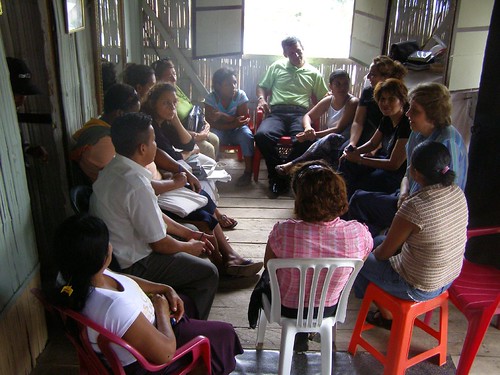
This is a typical story of how house churches get started in Guayaquil...
Mónica was hired to clean the house of a believer, Martha. Mónica began to open up with Martha about the problems she was having at home with the man she was living with.
 Martha would cry and pray with Mónica. She openly shared Christ telling her He could heal her life and home if she would just trust him. Mónica thought it too good to be true what Martha shared.
One day Mónica decided to invite Martha to come to her house to share the Gospel with her family. Martha took along Marlene, a gifted evangelist from the ho
 use church she attends. Marlene and Martha arrived at Monica's and gathered the family together to dialogue about spiritual matters. Monica felt strongly that she should give her heart to Christ. She was certain that she would be the only one to do so. Much to her surprise, Medardo, her daughter Aneida, and her live-in boyfriend David ALL gave their hearts to the Lord! From the very beginning, Medardo and David were changed dramatically by the power of Jesus working in their lives. Monica and Aneida were overcome with joy in the Lord.
That was September 2006. Marlene, Martha and others began 45-minute weekly bus trips to disciple their new converts. Both couples decided early on that it would be best to get legally married. Recently they were all baptized (see video here.) In Mónica and Medardo's home they
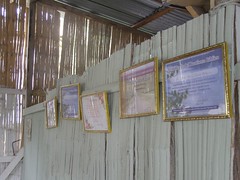 proudly display their framed new believer diplomas--Baptism, Discipleship I, Discipleship II, and Christian Marriage Certificate. In all I counted TEN framed certificates on their walls! Several others have since been won to the Lord. These new beleivers are being discipled by Medardo and Mónica. Both just completed our 7-week COSECHA to help them with their own church planting. They will now proudly add their new "Church Planter" certificate to their wall collection!
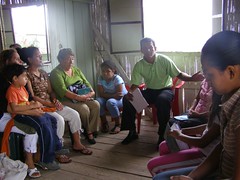 This past Sunday, Barbara Rivers and I were invited to visit the new church that meets in their home. We sang song after song as everyone wanted to make sure their favorite was sung. Medardo shared his testimony and a short devotional thought on faith. It was evident that he had worked hard on it all week knowing his "teachers" would be present. Prayers were voiced, the offering was collected, and words of encouragement were shared by
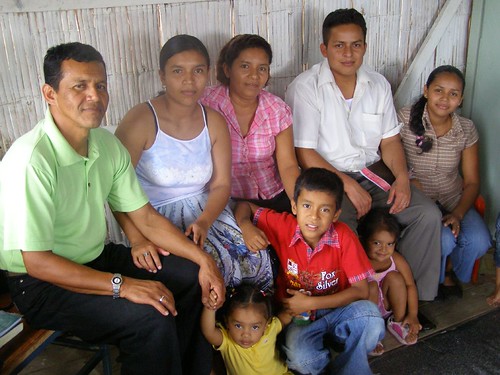 several. Medardo and Monica shared that just this past week their other daughter, Maria, had also accepted the Lord!!! They are overcome with joy that their whole family--including grandpa--has joined the family of God!
 After a lunch of chicken and rice, everyone gathered around Monica's sister, Rosa, to share Christ with her. She listened intently to all the testimonies of how Christ had changed everyone's life. Words cannot describe how precious it was to hear testimony after testimony of how Christ has totally transformed their lives, brought them happiness, freed them from the shackles of sin, and given them a purpose for living. Medardo even shared he had lost 20 lbs. since becoming a Christian. He called it "sin weight" that was taken away when he gave his heart to Jesus! Monica's sister Rosa has SEEN the change in her family's lives, and knows it is for real. Yet she was not yet ready to give her heart to the Lord. She will though, it is just a matter of time!
 After worshipping, sharing, eating, picture taking, and visiting together for nearly three hours everybody went home happy.
This is how house churches get started in Guayaquil. For all my years of studying and preparation, reading books, attending conferences, strategizing, fussing and fuming, church planting boils down to...
1) Someone going to share the Good News of the powerful life-transforming life that is found in Christ.
2) Making disciples of those who respond by walking alongside them in their initial steps of life in Christ.
3) Baptizing as soon as possible those who believe.
4) Teaching them to observe all Jesus commanded.
Should church planting really be any more complicated than that? If we will do our part, Jesus promises to do his part and BUILD HIS CHURCH.
Friday, June 1
Rethinking the nature and function of ekklesia
In Robert A. Lund's The Way Church Ought To Be he shares a list obtained from Robert Fitts for rethinking the nature and function of NT ekklesia.
- From meeting centered to life centered.
- From church houses to house churches (simplify to multiply).
- From special priesthood to priesthood of all believers.
- From super organization to simple organism.
- From bringing people to church to bringing church to people.
- From performance by professionals to "every one of you" (1 Co.14:26).
- From program-based church to home-based church.
- From titles to function.
- From independence to inter-dependence.
- From paper membership to Body membership.
- From "us and them" to "us".
- From local vision to world vision.
- From building my kingdom to building THE kingdom.
- From wall-wide church to city-wide church.
- From Christianity to Christ (not a philosophy, movement, or religion, but JESUS!)
- From pastor only to five-fold ministries (we need ALL the gifts God gave to the church).
Subscribe to:
Posts (Atom)