Saturday, September 29

3rd man in history to walk on water

Gary Snowden recently challenged us with the following quiz on his blog. See if you can answer correctly...

Who was the 3rd man in history to walk on water?

*
*
*
*
*
*
*
*
*

The first to do so was Jesus (Matthew 14:25).

*
*
*
*
*
*
*
*
*

The second was Jesus disciple Simon Peter (Matthew 14:29).

*
*
*
*
*
*
*
*
*

And then there was this guy...


Thursday, September 27

How missions minded are we really?

IMB reporter, Mark Kelly, has written an interesting news report quoting Gordon Fort, IMB vice president of overseas operation who asks, how missions minded are we really?
RIDGECREST, N.C. (BP)--Many Southern Baptist churches that pride themselves in being "missions minded" might have a hard time convincing an impartial observer, an International Mission Board leader told trustees Sept. 12 at LifeWay Ridgecrest (N.C.) Conference Center...

"As I travel, I hear a lot about how 'missions-minded' Southern Baptists are," said Gordon Fort, IMB vice president of overseas operations. "I often ask, 'How much does your church pay for utilities each year?' Then I ask, 'If you are paying more for your utility bill than you are giving to reach a lost world for Christ, how does that make you a missions-minded church?'"

Southern Baptist churches ought to re-examine just how high a priority missions really is when they claim a total of 16 million members yet have only 5,234 international personnel currently under appointment, Fort said.

"Southern Baptists are great to talk about tithing," he told the trustees. "I want to ask whether a church shouldn't tithe its membership to reach a lost world?" Even if just 1 percent of 10 million active Southern Baptists were to enter the mission force, "we would have 100,000 missionaries. Instead, we have 5,000."

Fort noted that IMB leaders have a vision "for 3,000 more active missionaries on the field.... Adding 3,000 new missionaries might be a difficult task if we were starting out with no resources, but the truth is that those 3,000 new missionaries are already sitting in our churches, and the finances to support them are already in our pockets. It's not a hard task."
Some tough words that cut to the chase about our being a so called 'missions minded' people. Here are some more quotes to ponder along the same lines...

Some people God calls upon to LIVE radically and sacrificially, while others He calls upon to GIVE radically and sacrificially. Which are you? --Maurice Smith

It is amazing how strongly what we do affects how we feel. --Elisabeth Elliot

Let my heart be broken with the things that break the heart of God. --Bob Pierce

Tuesday, September 25

What a difference you've made in my life (Part 2)


Recently I posted the ongoing story of Aneida in a post entitled What a difference you've made in my life. Alan Knox commented, "This is one of the most important posts that I've ever read!" I don't know about "important" but it is definitely one of my favorite "M Blog" posts. This story just keeps enfolding day by day, getting better and better...

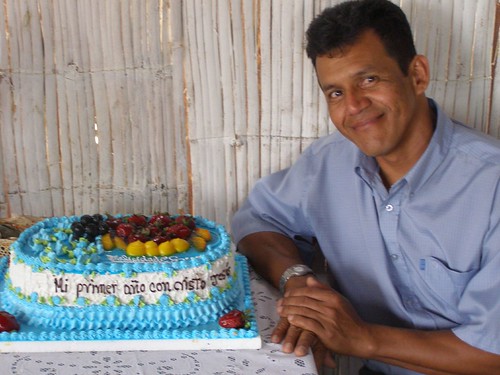
Last Sunday, Medardo (Aneida's dad) invited us to his house to help him celebrate his first birthday of being a Christian. (Cake at left reads, "My first year with Christ Jesus.") It was exactly one year ago that Medardo accepted Jesus into his heart for what has become a remarkable transformation, in not only his own life, but in the lives of his entire extended family. Over the past year his wife Mónica, his daughters Aneida and her husband David, Aneida's sister, María, their grandpa, David's brother and sister-in-law, his other brother and his wife--along with so many others that I could never get it all straight...including several neighbors and friends. Then there is an entire family that Medardo works with on his job. He and Mónica are currently discipling them. This family was recently baptized and they have started a house church in their home as well. I know its a lot of people and it gets confusing...but that's the point!

Medardo and Mónica led the house church celebration time. We sang all their favorites out of the green song books we use. Medardo shared his testimony of all that Christ had done for him and his family. We listened to words of exhortation and encouragement for Medardo from all those who had been invited. Prayers were voiced. A few more songs...and then everyone was treated to a big plate of delicious fritada, mote, arroz and onion-tomato salad, with cake for dessert!

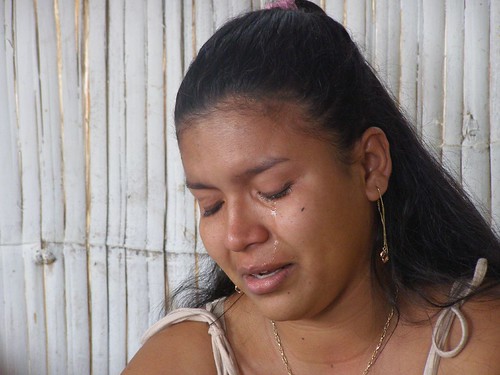
There was only one moment of sadness when María shared her grief that her husband (who had not come to the party) was not yet a believer. Tears streamed down her face as she asked us to pray for her husband's salvation.
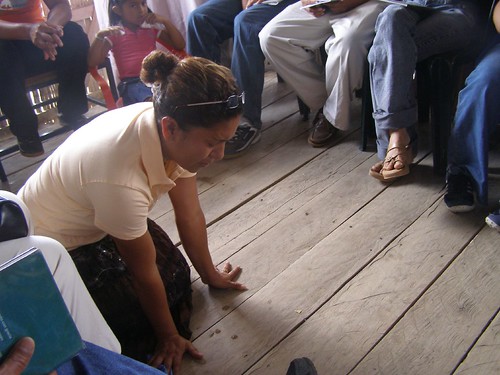
Without warning her mother, Mónica, fell to the floor and cried out to God to save her son-in-law. The weeping and crying went on for several minutes as all present called upon Jesus to do what only He can do in working the miracle of changing a life. Will you pause a second and pray for María's husband to come to know the Lord?

I know there will be Parts 3,4,5 ... to this story. God isn't finished yet! This is what Jesus is all about. He is an awesome God who is about making all things beautiful...including saving María's husband. Stay tuned!

Sunday, September 23

Church without all the religion

What does church look like without all the religion? Describing house/simple church life can be difficult to explain. It must be experienced. Much of what we try to write about on the "M Blog" often comes across more theoretical and idealistic than something that real people are actually living. The following video "When You Come Together" from House2House Ministries does a good job expressing in sound, images, and commentary much of what it is we seek to express here on the "M Blog". So, what does church look like without all the religion?

Click HERE to watch!

Download this episode (right click and save)

Thursday, September 20

The 3 P's of church planting

Try reading aloud the following lines...
All atouhirty has been gevin to Me in haeevn and on eraht. Go terherofe and mkae dipsiciles of all the notians, bipatizng tehm in the nmae of the Fehtar and the Son and the Hloy Siript, ticheang tehm to osberve all that I cammonedd you; and lo, I am whih you ayawls, eevn to the end of the age.

Even with the atrocious spelling, I am fairly certain that 99% were able to read the paragraph with minimal difficulty and understand the message. Why?

1) you had a pretty good understanding of the general context of the message.

2) the first and last letters of each word are correct and the mind reorders the middle letters to their proper place.

The above paragraph is what our church planting looks like more often than not. It is a jumbled mess, yet somehow, God breaks through and does something beautiful to iron out the wrinkles.

So, if the overall context is important, and the first and last letters are important, how does this translate into the 3 P's of church planting?

The three most important words in church planting are...

Prayer
Passion
Perseverance

Prayer is the most important ingredient for a church planter. Prayer gives us the needed guidance and context for understanding God's ways. Prayer keeps us on course even though we may make a huge mess of things between steps in the church plant.

The second most important words for the church planter are passion and perseverance. If the first and last letters are needed to make sense of a word, passion and perseverance are the equivalents needed to see churches planted. When passion and perseverance are on the ends of each church planting step, a lot can go wrong in between and still come out OK.

I find it reassuring to know that if I will focus upon prayer at the center of my life and ministry, asking the Spirit to fan the flames of passion within, and persevere regardless of the ups and downs along the way, God will take care of the rest. He will reorder the "letters" in such a way that His church gets planted.

You can make a lot of mistakes in church planting but when prayer, passion, and perseverance are present there will be power.

Tuesday, September 18

Ecuador missionaries commissioned to the USA

I never thought I would live to see the day when we would actually commission missionaries from Ecuador to go to the USA. Yet this is exactly what took place yesterday, Monday, as Roberto and Nancy left Ecuador for the United States of America.

Roberto and Nancy Aveiga have been with us for several years. His own testimony relates that he was a discouraged pastor of a tiny church, not having a clue what to do, or how to do ministry. He came to one of our church planting seminars three years ago and has been with us ever since. Roberto and Nancy have pastored churches, planted new works, participated in our TE programs, discipled and baptized new believers, trained pastors of their denomination with materials they have learned from us, and now sensing God's call as missionaries to a distant, foreign land--the USA!

After praying, conversing and counseling with Roberto and Nancy, we feel it is no coincidence that on their FIRST ATTEMPT to obtain the coveted residential/work visas to the USA that millions around the world are desperately trying to obtain, they were not only accepted, but their ENTIRE FAMILY was approved! God doesn't do things haphazardly. There is no such thing as chance when it comes to Kingdom business. We feel this is a "God thing" that He is clearly leading them to go, make disciples, baptize, and teach as "our" missionaries to the USA (Connecticut.)

This past Wednesday at their commissioning service, we heard their testimonies about how God has been preparing them for years. And how crucial their time with the house churches has been. Now they feel the Lord leading them into the next chapter of their walk with Him. God is leading them to leave their country, go to what is the third largest nation on the planet--the USA--and be His witnesses to the masses of lost people coming in the northeastern states.

Roberto and Nancy know it will be a tough road. They aren't expecting things to be easy. They have to first learn the English language. They will have to adapt to the strange foreign foods and cultural ways of the "gringos". Since the house churches here can't afford to support someone living in the USA, they will have to find jobs and work as bi-vocational missionaries. They will lose their network of close family, friends, and brothers and sisters in Christ. They will no longer be able to pick up the phone and call us with their questions, needs and concerns. In short, it will be difficult.

Will you pray for Roberto and Nancy? They aren't going for a "better life" or to live the "American dream". They are going to make disciples, baptize, teach, and gather new believers into NT churches. Just what they have been doing for the past three years locally. As I shared in their commissioning service this past Wednesday night, in the OT, only the best was offered to the the Lord in sacrifice at the tabernacle/temple altars. The same holds true today. Our Lord calls out the best amongst us to serve him. We are sorry to lose some of our choicest workers, but are filled with joy that we can share our best with the lost and needy of Connecticut.

May God bless these Ecuadorian missionaries sent out by the Guayaquil house churches for the Glory of God.

Sunday, September 16

Nine issues concerning CPM methodology (#1 of 9)

Mid America Baptist Theological Seminary's, Journal of Evangelism and Missions, features "Church Planting Movements" (commonly referred to as CPM) in its Spring 2007 issue. Therein is a balanced selection of articles praising, explaining, and questioning CPM.

The first article is probably the most controversial with an IMB missionary, Jeff Brawner, making 9 tough observations about the IMB's CPM methodology. You will either find yourself saying AMEN to what he writes or watch your blood pressure rise in disagreement!

In AN EXAMINATION OF NINE KEY ISSUES CONCERNING CPM, Brawner's first observation is...

1. The movement often pushes missionaries to plant churches and disciple leaders more quickly than the biblical pattern. Sitting at the IMB International Learning Center a few years ago during my first furlough, a CPM trainer explained to me how to approach discipleship on the field. He used the illustration of a mother duck and her ducklings. The mother duck leads (representing the missionary), and she guides the first duckling. Each successive duckling follows their sibling in front of them rather than the mother duck. Each duck stays a few steps ahead of the other. As missionaries, we should teach our disciples sound principles, and each disciple should begin to pass those principles to others as quickly as possible. In this form of discipleship, each disciple stays one step ahead of the next generation of disciples. I questioned the speaker on the biblical pattern of discipleship. After all, if Christ invested three years in his disciples, doesn’t that mean we should spend a great deal of time with our disciples? In my view, a young disciple is not ready to lead others immediately...Christ was preparing leaders that would go out and start multiple churches around the world. Is that not exactly what missionaries are supposed to do today?...how can we, in good conscience, not thoroughly pattern our ministries after Christ’s example?...Should we take three years with our disciples? Scripture does not mandate that we spend that length of time; however, one can see from the Gospels that it takes time to mold solid, godly men. From experience, one can see that Scripture holds true-new believers are extremely susceptible to temptation, backsliding, and heresy. Is it not obvious that Paul understood this as he gave us guidelines of who to promote to leadership levels in 1 Timothy 3?
We would fall somewhere in the middle on agreeing with this first of nine critiques. What is the biblical pattern for discipleship? When is a disciple ready to plant a church and/or disciple leaders? From our experience it has little to do with the amount of time one is a believer. We have had new believers who have been Christians only a few months begin new works. Likewise we have seen believers with years in the faith start new churches. To us the key is more about how much the believer obeys and puts into practice that which they know. It doesn't take a lot of knowledge to "go, make disciples, baptize, and teach..." What it does take is obedience. Those who put into practice the little (or much) that they know, will bear fruit.

The idea that CPM "pushes" otherwise unready believers into the harvest fields has not been our experience. What HAS been our experience is that we can't expect ALL believers (new or old) to realistically go out and start new works. It would seem some believers are "wired" to do this kind of work, and others are not. Our task is to find, motivate, equip, and send out those chosen few. To find those few "wired" individuals, we have to train and deal with a lot of people. While not anywhere near exact, it would seem that about one out of every ten believers we train (whether new or old) turn out to be effective church planters/workers/laborers/disciplers, etc. What that means is that if we want to see ten new churches started this year, we are looking at having to spend the time and train around 100 potential willing-to-be-trained workers.

Any comments or observations about #1 above from your own perspective and experience?

Friday, September 14

Reggie McNeal's six tough questions for the church

The longer we are engaged in missional church planting, the more I find myself going back to Reggie McNeal's, The Present Future: Six Tough Questions for the Church. This courageous book first came out in 2003, and has been challenging my thinking ever since. In the book McNeal describes the church in terms of six "new realities." The related questions to each of the realities are ones we find ourselves struggling with in our own life and ministry.

1. The collapse of the church culture.
  • Wrong question: How do we do church better?
  • Tough question: How do we deconvert from Churchianity to Christianity?
2. The shift from church growth to kingdom growth.
  • Wrong question: How do we grow this church?
  • Tough question: How do we transform our community?
3. A new reformation: Releasing God's people.
  • Wrong question: How do we turn members into ministers?
  • Tough question: How do we turn members into missionaries?
4. The return to spiritual formation.
  • Wrong question: How do we develop church members?
  • Tough question: How do we develop followers of Jesus?
5. The shift from planning to preparation.
  • Wrong question: How do we plan for the future?
  • Tough question: How do we prepare for the future?
6. The rise of apostolic leadership.
  • Wrong question: How do we develop leaders for church work?
  • Tough question: How do we develop leaders for the Christian movement?
Of these six, the one we are focusing upon the most in our own ministry is #4. We are passionate about developing followers of Christ who understand the difference between religion and relationship. In our own context there are 800,000+ believers sitting in the pews of churches all across this nation. It is my conviction that "followers of Christ" were not made to sit in pews week after week. Their relationship with Christ calls for a response like that of Isaiah, "here am I, send me." We are actively seeking to deconvert disciples from "Churchianity" to Christianity.

Which of Reggie's six points above resonate with you? What are you doing to address these issues in your own life and ministry?