Wednesday, February 6

Dealing with painful real life issues in house church

A few months ago we were sitting around in a house church gathering when one of our sisters in Christ received a call on her mobile phone from her incoherent drunk husband. Our sister (we'll call her Rosa) was frantic because her two small children were with her husband and he wasn't faring well with them under the influence of the alcohol.

The bad part was Rosa did not know where her husband was living. They were separated. And Rosa could hear her scared children crying in the background. We finally managed to get someone on the line who could give us directions to the house. Rosa asked us to pray for her as she had to go get her children. After doing so, my wife accompanied Rosa to help get the children back to safety.

Upon arrival, Rosa saw that there was another woman at the house with her husband--something she had long suspected--but until that moment, had no actual proof.  She confronted her husband about having an affair and he was forced to confirm the fact.  Rosa's husband then began to get hysterical and told her to "get the _ _  _ out of there!" Rosa and my wife brought the kids back to the house where the church was praying.  Needless to say, they were in bad shape upon arrival. What do you say to someone in their moment of shock, bewilderment, anger, and grief? How do you explain things to those innocent children whose world is being torn apart?

As we gathered around Rosa we asked her how she felt. She opened up and through tears running down her face shared her raw feelings. It wasn't pretty. We, again, prayed over her and affirmed who she is in Christ, and to not let Satan further beat her up with his lies. We tried to express to her how much she is loved by God and us, her family in Christ.

After talking a while, Rosa asked if we thought it was a good idea she talk to her children about all that had happened. Up until then she had been "covering" for her husband and had not told them anything that was really going on. We affirmed her idea saying we thought it would be a good thing.  Mind you, all of this is taking place during the regular "church service."

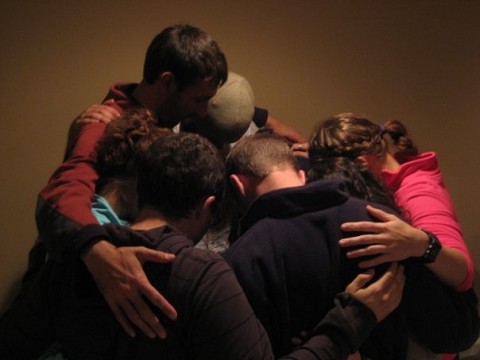
At that point we gave Rosa a few minutes to collect herself, and then called her children into the living room. Rosa bravely shared for the first time with them the truth about what what had been going on and why dad was no longer living with them.  I thought she did a wonderful job of balancing the pain, while at the same time affirming that both parents loved them, and that they were not at fault for anything that had happened. We gave some time for the children to talk and ask their questions as well. Then all of us huddled around the family for another time of prayer.

Why do I share this? Because real life can be very messy. Pain is real. Believers are not exempt from bad things happening to them. Church is more than a nice service, a challenging message, or great worship. It is being a family together on mission with Christ to redeem a broken and sick world with the Good News.

Real families stick together through the good, bad, and ugly times. Real families stand up and fight for one another and don't abandon each other in the middle of crisis. Real families love one another and treat one another like, well...real family!  This is church. It isn't always pretty, but we are the redeemed, beloved Bride of Christ. The Chosen Ones. The ones He loves, heals, redeems, and restores. We, the church, are His eyes, ears, hands, and feet in today's broken world. We all need encourgement. We all need feedback. We all need one another when going through tough times.

Thank God for the church. I am glad to be part of churches like this one.

Monday, February 4

What missionaries wish they had known before going overseas*


*I wish I had had more realistic expectations.

-Answer from Mike in West Africa...
 
I could make a similar comparison to marriage. Many girls and young women have unrealistic ideas about the romantic bliss found in marriage and never see the problems or day-to-day hard effort needed to really make a marriage work. Missions is no different. In most missionary presentations,you hear about all the victories and what great things the Lord is doing. I think that is for two reasons. First, missionaries are trying to recruit people into the work, so they strongly emphasize the positive side. Second, most people, and maybe especially missionaries, don't want to be vulnerable and reveal that they have problems. This is not helped by the fact that church people want to put missionaries on a pedestal as super spiritual for being willing to sacrifice "all" and live under harsh conditions. So it is important to talk with missionaries one-on-one so you may be able to hear their struggles as well as their victories.

Another common fallacy is that the "heathen" are crying out for someone to tell them the gospel. There may be the rare exception (in Papua New Guinea, one tribe did build a church in anticipation of the missionaries coming to tell them the Good News), but in general, the "heathen" are blinded just like the Jews. They are not searching for God and are living deceived in the darkness of their blinded condition. One will most commonly find indifference to the message, and at worst, there will be downright opposition.

I am often amused by missionaries who have the idea they are going overseas to do a great work for Jesus. First of all, we are participating in the work that God is already doing. This is well-explained in the workbook Experiencing God. Of course, all your friends here will tell you what a great and wonderful thing you are doing. Then WHAM! You come face to face overseas with all your inadequacies and weaknesses. You realize how much you are actually going to have to depend on God to see something accomplished. Many missionaries when confronted with the reality of living in a foreign culture and the time needed to impact the people simply become discouraged, turn around and come home. It is only when we realize that we are totally dependent on God and wait on Him and work with Him that we finally see some beautiful fruit.

I wish I had known how difficult missions really is.

-Answer from Tim, who has been a member of Wycliffe Bible Translators since 1974, serving in Cameroon and the United States...
 
I would have gotten more cross-cultural training, especially focused on the culture to which I was going. I would have taken more time in language learning. But most of all, I needed realistic expectations. Working in a foreign field is the same as being in a war. I know. I've fought in both and the similarities are striking. There is not much glorious about warfare. It may look exciting on TV or in the movies, but in the trenches it's real life, and people get hurt and die. It's a lot of hard work, sloshing thru the rice paddies. It stinks. And the enemy has ambushes everywhere. Often you can't tell the enemy from the friendly. And your friends get injured and killed. It hurts.

The culture won't make a bit of sense and you'll even resent the people sometimes, or think how ridiculous they do things. But you will learn how to live there. You'll learn new cultural cues and you'll begin to see how they do make sense in your new culture. And in the learning, you'll grow to love the people. So learn to laugh at yourself!

Don't give up! When you go, determine that you're going to stay. It's like God meant marriage to be. It won't always be easy, but make it work! Don't expect the other person to change. Change as you need to. And there's probably no better environment to promote change in us than working in another culture.
 
I wish I had known language learning & missy relationships.

-Answer from Mike in West Africa, who is translating the Bible with WEC International.
 
Language learning is a long process. Most North Americans have never learned a language and do not understand the time, work, and patience needed. Even some missionaries don't see the importance of learning the language.

Most adults do not know how to handle the humiliation of learning a new language, of having people give them confused stares, just outright laughing at them, or becoming angry because you are in their country and can't speak the language. Many people in my language school suffered from loss of identity and inferiority. These were well-educated people who had been successful in their occupations back home. Now they were learning language full-time and couldn't understand why they were having such a hard time when they did so well in their home occupations. They didn't understand that learning a language is a completely different animal than making good grades in history or nursing. Being "smart" does not guarantee that you will automatically find learning language easy.

Never assume that you and your colleagues are going to be one big happy family. Generally you cannot choose who you are going to work with and no one is going to hit it off with everybody. So you may find that your colleagues have different interests and backgrounds that you cannot relate to well. You may find that they do things that are quite irritating to you. You may find some of your colleagues to be quite carnal, having major problems with anger, critical spirit, gossiping, etc. Good relationships take a lot of time and effort. I would say that it is just as important, if not more so, to spend time "bonding" with your colleagues as well as bonding with the nationals.
 
I wish I had learned about spiritual warfare.

-Answer from Tim, who has been a member of Wycliffe Bible Translators since 1974, serving in Cameroon and the United States.
 
I wish I had known more about my relationship to God and about spiritual warfare. One book every Christian should read is Victory Over The Darkness by Neil Anderson. This will help you understand and recognize spiritual warfare. Wherever you're living right now, you're in the middle of a battle. We need to understand the nature of that battle so that we can be victorious over our enemy. When we cross over into another culture, where satan has built his strongholds for centuries and where cultural cues vary, the battle looks different. However, our victory over the powers of darkness is still in Christ.

We all have much to learn in this life, and much of what God has to teach you, you'll only learn by going where He leads. So do some good thorough preparation, and then GO. Don't ever think you've got to be totally prepared before you go, or you'll never go.
 
I wish I had known how difficult long-term fruit really is.

-Answer from John McVay, who wrote the following after serving one year in western Europe.
 
On a short-term you may go to a responsive area and see numerous decisions for Christ. But among less responsive people-groups, missionaries often struggle with spiritual infertility. Sometimes those who make a decision may not follow through. On a short-term you saw people pray for salvation and then you were back on the plane. But as a missionary you may discover that this "convert" no longer even wants to see you.

If you want to see people saved, you need to spend time with non-Christians. But we were amazed at how much of our time was tied up in fellowship with other missionaries, people in the church, other national pastors, and friends who visited. We started to ask, "When was the last time we saw a non-Christian?" Then God led us to make contact with a pre-Christian every day. As part of this we invited families over for dinner once a week. Though few outsiders would come to a church meeting, no one turned down a dinner invitation!

Missions is sometimes a huge challenge. During our darkest days I would read Hebrews 11 aloud twice a day and pray for the faith to keep going. One day I continued into the next chapter and read Hebrews 12:11 "No discipline seems pleasant at the time, but painful." I wondered if the Lord was disciplining me. Had I been disobedient? Then I read Hebrews 12:7 "Endure hardship as discipline. God is treating you as sons." Then I saw it. The hardship is something that God brought into my life. Then I reread verse 11 and exchanged the word discipline for hardship. "No hardship seems pleasant at the time, but painful. Later on, however, it produces a harvest of righteousness and peace for those who have been trained by it." Like a good marriage, effective missions takes work. But it's worth every bit of it, too.
 
I wish I had known more about myself and being patient.

-Answer from Bethany who is serving in the Middle East with the Assemblies of God.
 
Here are my pearls:
  • Boredom is real. I heard that before I came, but I have found extreme periods of down time that I used to fill so easily. The first two months or so in a new place are the hardest as you establish new friendships and a new pattern of life.
  • Knowing yourself is very important. I have been stretched a phenomenal amount, especially in the first months of my assignment. If you have skeletons in the closet, God will bring them to light. Be willing to deal with them as they come up; don't push them away. God needs to break you to use you.
  • Be teachable and be a lifelong learner. It's easy to just depend on your ability to "figure it out once you get there," as firsthand knowledge may seem more dependable than book knowledge and theories. It's not true. Know before you go.
  • It takes time to ease into the structure. At home, I had lots of energy to fill my day from early morning to late at night. On the field it seems I tire so quickly. Realize that being stretched physically, emotionally, spiritually, and facing a new culture, language, living situation, etc. wears you out. It's okay to slow down. Being a missionary is not about being superhuman and accomplishing a long list each day. Some days all you'll accomplish is a trip to the grocery store or a government office. It's about trust and obedience and hearing the Master's voice.

  • I wish I had known how nationals view the economic status of missionaries.

    -Answer from Mike in West Africa, who is translating the Bible with WEC International.
     
    To me, my standard of living is drastically lower in a developing country. But no matter what level one lives at, the fact remains that you will always be considered wealthy in the eyes of the nationals. And in fact, you are wealthy. In our local currency $2,000 US dollars would equal a million, so almost all the missionaries are "millionaires" here. And even if you find it hard to live on the support you receive from back home, you still had enough to pay a ticket to come here, whereas your everyday national could never pay a plane ticket to visit another country.

    Also, one encounters the common idea that it is the duty of those with more money to distribute it to help others. So the nationals will never look at someone who has more money than them and lives at a higher level than them, and drives a car, as someone who is making a sacrifice. Don’t expect to be congratulated or thanked for the sacrifices you made to come. Americans in particular (and I speak as one) seem to have the idea that we must be constantly affirmed. Better get over that before heading overseas.

    Another fallacy is that nationals should applaud that you have "sacrificed all" to bring them good news about Jesus. The reality is that they probably won't give a hoot! Many missionaries go with the idea that they should be "appreciated" by the nationals for the sacrifices they have made. And of course we cannot serve God if we are not appreciated! Pray to be humbled now, before going out and being humbled overseas. Of course, depending on your job (doctor, nurse, well-digger), you might be better received than just a general evangelist. Or if you come to work a specific job by the church, they will be more appreciative than non-Christians. But I guarantee there will always come a time when you will feel that you are not "appreciated" (whether by the church, the heathen, or even your own colleagues).
     
    I wish I knew how to deal with conflict.

    Answer from Paul in CA who has served in Uganda and Rawanda for two years.

    When you want a job you usually put on your best for your prospective employer, like a first date, you hide all the bad and accentuate the positive. Unfortunately, I discovered after two failed attempts to work with missions agencies, this not a good way to "get married" to a sending organization.

    Just like my former wife and several bosses, I fell in love too fast, accentuated my and their positive points, and didn’t ask the critical question "How do they fight through a problem?" Neglect to do this and you will get seriously hurt.

    When you know how a spouse, boss, friend, co-worker, pastor, or mission agency resolves conflict you will know your chances of being able to have a long term relationship with them. Nice Christians who resort to threats, gossip, slander, lawsuits, giving the silent treatment, bullying etc. don’t tell you up front this is how they deal with conflict. You have to know them well before you commit to a long-term relationship. So find out how they fight before you sign up.

    _____________________________________________
    *Reprinted from Ask A Missionary website which seeks to answer the common questions posed by people considering missions service overseas. The above is taken from the article,  "What missionaries wish they had known before they first went?"

    Sunday, February 3

    Our shifting missionary role


    Someone once defined missionary success as working oneself out of a job. When Linda and I arrived in Guayaquil, Ecuador as missionaries in December of 1987, we served in the center of where the action was taking place. We were in high demand by the churches, associations, and Ecuador Baptist Convention and all their related institutions and programs. Our advice and opinions were respected and listened to. Constantly we were called upon to preach, teach, administer, counsel, train, and coordinate ministries, institutions, and strategy. Rare were the days when we had an entire evening to ourselves without someone in our home, someone dropping by to chat, or the phone ringing day and night.

    Over the years, all of the above has continued to decrease to, what is today, a mere trickle of what it was 20 years ago. Has the work diminished? Not at all. In fact, far more is happening today on multiple levels than anyone could have ever imagined. But our own personal influence and role has diminished from what it once was. Our role has changed. While we are certainly still loved and respected by our Ecuadorian brethren, the things we used to do--as "principal actors on stage"--are now being done by those we once poured ourselves into years ago. The very men/women/youth we taught, counseled, trained, and encouraged have today taken our place. They are the ones now that others call upon, serve in "important" capacities, speak, teach, train, travel, lead, preach, etc.

    As I reflect back over the years of all the assignments, responsibilities, tasks, and roles we have played; ALL, without exception, are today in the hands of nationals who are doing an excellent job and we are so proud of them and the way they have risen to the task and call of our Lord!

    So what are we still doing here if we have successfully worked ourselves out of all our jobs?

    The task itself is far from completed. With only 7-10% of the population in Ecuador followers of Jesus Christ, much remains to see the Great Commission fulfilled in our region of the world.

    What I sense is most needed is not more missionaries continuing to come from other parts of the world, but  a shift in role existing missionaries play. Ecuador is today positioned to be a primary missionary sending nation, and less a missionary receiving nation.

    We "outsiders" who remain must see ourselves more in the apostolic roles of encouragers, enablers, equippers, trainers, motivators, connectors, and coordinators who are principally engaged in mobilizing God's people into the ripe harvest fields--not as fun as front line stuff, but necessary!

    While there will always be room for the first generation apostolic church planter who goes into unreached/under-reached territory to proclaim the Gospel, make disciples, and leave a NT ekklesia; in the later stages of a ripe harvest field (like Ecuador) we best serve the King by shifting our focus to helping the church see what remains to be done, how to accomplish the task, provide tools and training, and mobilize to lead hundreds of laborers to bring in the harvest God is giving.

    I can feel great about spending 30-40 hours a week directly engaged in proclaiming the Gospel, making disciples, baptizing 15-20 and hopefully planting 1-2 churches in a year's time...

    ...Or, I can spend that same time modeling, training, mobilizing several hundred others to do the same things, and at the end of the year see the Kingdom grow by dozens of churches and hundreds of baptisms and scores of new disciples also equipped to going out and making even more disciples.

    In the first role we are the primary actors on stage. Everyone sees us, needs us, and looks to us for direction. In the second we are behind the scenes and the ones "seen" are those we are coaching. The difference in the way we understand our apostolic/missionary role is between planting a church, and being an instrument in the Spirit's hands for dozens of churches planted all over the region.


    Thursday, January 31

    Conversational prayer

    Over the years of working with house/simple churches one of the most meaningful segments of our gatherings are the prayer times. We train church planters to practice several different ways of praying. One of these ways is conversational prayer.

    Acknowledge God’s presence in the group. Praise and adoration is always good to help focus the group on communicating with the Lord.

    Pray short prayers of one, two or three sentences.

    Pray about one subject, idea or person at a time until everyone has shared as much and as often as prompted by the Spirit.

    Be reluctant to change the subject as you would in any conversation until everyone is finished with it.

    Times of silence can give the timid and the thoughtful time to contribute.

    The more the conversation with God is passed around the group the deeper the intimacy grows. In time a small group becomes totally unified and purely transparent.

    Watch God’s love flow freely, lives transform and answers to prayer abound.

    Tuesday, January 29

    10 reasons for sending out workers in pairs*


    1. Travelling in groups of two or more was Jesus’ and the apostles’ consistent practice. To avoid working alone is patently biblical. There are at least three levels of authority for what churches and missions practice: 1) the commands of the New Testament, 2) practices of the New Testament that were not commanded, and 3) church traditions that were neither commanded nor practiced in the NT. Christians historically have preferred to adopt apostolic practices except when those offend local culture or cause more harm than good.

    2. There is more power from God when two agree together in prayer. Jesus promised, “If two of you agree on earth about anything they ask, it will be done for them by my Father in heaven” (Matt. 18:19). Since evangelistic outreach into non-Christian regions faces continual opposition from the devil and evil persons, workers can benefit from concerted prayer. Two or more who go together can pray together.

    3. Two workers can usually bring more spiritual gifts into play than can one. Since gospel workers have as their objective to evangelize families and plant churches in the homes of receptive folks, they will be better equipped to do so by the gifts of the Holy Spirit in each one of them. God promises to give to churches apostles,prophets, evangelists, shepherds and teachers who can equip those churches (Eph. 4:11-12).

    4. One worker may have teaching gifts and another, other practical gifts. Fulfilling both the Great commandment to love God and neighbour and Jesus’ Supreme command to make disciples, dual workers can use both speaking gifts and serving gifts (1 Pet 4:11). The two ‘Great’ commands (‘Great Commandment’ and ‘Great Commission’) are like the two wings of a bird. Working together, the bird flies with confidence. If the feathers of either wing are clipped, it only goes in circles, as do church bodies that fail to balance the two ‘Great’ commands. Ministries that serve both the spiritual and physical dimensions of local communities normally prove more effective at both than does a ministry that ‘specializes’ in one or the other.

    5. Two workers can experience the Presence of Jesus in their midst. Two workers can be more certain of the “voice” of the Holy Spirit leading their activities and granting them insight. As soon as the two have led a third to faith in Jesus, they already qualify as a nuclear church in which Jesus dwells (Matt. 18:20). This promise of Jesus makes worship and Body life a reality from the earliest days of a church plant and provides a model for the reproduction of new cells and congregations.

    6. Dual workers serve as reliable witnesses to the outcomes of their work. When the Apostle Peter went to the home of Cornelius in Caesarea, he took along with him six brothers from Joppa who served as witness to the unexpected outpouring of the Holy Spirit upon non-Jewish believers (Acts 10:45; ll:12). Reliable testimonials can encourage others and confirm outcomes. In some cases, workers can better defend each other in cases of false accusation as well as in courts of law, discouraging wanton attacks against a worker who goes out alone.

    7. A pair of workers can encourage each other keep each other accountable. Lonely and frightened gospel workers can easily fall prey to their fears and to various kinds of temptations, whereas a pair of workers can more easily resist incitement to sin and can reason together about obstacles to their work (2 Cor. 7:6). While it can happen that co-workers come to a glad parting of ways, it is more usual that they remain encouraged by each others companionship. In our experience as mentors of church planters, most serious failures, both moral and strategic, have occurred while workers were travelling alone or during the fatigue that follows ‘mountain top’ ministry, such as Elijah’s suicidal depression after his triumph on Mt. Carmel (1 Kings 18-19).

    8. When one worker trains another, they will often go out together for a time. Neither Jesus nor his apostles made it a practice to work alone; they both normally chose coworkers who were less experienced than themselves, because they saw in their apprentices a potential to become effective workers (Acts 16:1-3). In Acts 13, it is reported that the Holy Spirit sent out Barnabas, the more experienced, and Saul. Later, Saul, called Paul, became the more prominent. Travelling with less experienced workers is a key component of mentoring.

    9. When one worker is detained at a place, the other can go or return where needed. Because Paul had taken co-workers with him to most localities, he was later able to leave one at a place or send one where they were recognised (1 Tim. 1:3; Tit. 1:5; Col. 1:7). An independent worker can easily die, become disabled or be detained, leaving earlier contacts undeveloped.

    10. A pair of workers appears more serious and important to sceptical communities. Whereas an individual can be taken as a marginal babbler (Acts 17:18), two may gain a hearing. Local communities will look upon a pair of workers as representatives of a community or an organization, when a single worker may be mistaken for a fool.

    -------------------------------------------
    * The above material for sending out workers in pairs comes from Galen Currah and George Patterson's MentorNet #38, entitled, "HE SENT THEM OUT TWO BY TWO." For similar materials check out their website at http://www.paul-timothy.net/ and http://www.MentorAndMultiply.com

    Saturday, January 26

    Mi sueƱo para el Ecuador es ver a:


    1--cada creyente haciendo discĆ­pulos
    2--cada casa potencialmente una iglesia, y
    3--cada templo un centro de preparación y una casa de oración 24/7

    ¿Cómo transformar este sueƱo en realidad?

    1--reducir a un mĆ­nimo el nĆŗmero de cultos en las iglesias (los cultos no producen discĆ­pulos)
    2--capacitar a cada creyente para ser un discĆ­pulo que hace discĆ­pulos
    3--empoderar, enviar, apoyar y bendecir los esfuerzos de cada discĆ­pulo al salir a hacer discĆ­pulos en cada rincón de las ciudades, los cantones, pueblos, recintos, provincias, y hasta lo Ćŗltimo de la tierra

    ¿Cómo empezar?

    Todo empieza con mi oración personal, "heme aquĆ­; envĆ­eme a mi, SeƱor."  No esperarĆ© a que otros lo hagan, yo lo harĆ© comenzando ahora mismo orando a Dios para que me dĆ© dos almas con quienes puedo comenzar a trabajar.

    Con dos otras personas formo un "Grupo de Tres"* ganƔndoles para Cristo y discipulƔndoles. Serƭamos tres personas creyentes.

    Los dos nuevos discĆ­pulos siguen mi ejemplo y cada uno de nosotros buscamos ganar y discipular a dos personas mĆ”s. Con esto serĆ­amos seis personas.

    Las seis tambiĆ©n buscan ganar/discipular a dos personas mĆ”s. Ya serĆ­amos doce personas en nuestra nueva comunidad Cristiana.

    En un aƱo yo personalmente me responsabilizo de ganar y discipular a seis personas en total. Y estas seis imitan mi ejemplo y hacen lo mismo durante el lapso de un aƱo.

    Si de los supuestos 2-millones de creyentes existentes en el Ecuador, solamente 100.000 de ellos (el 5%)  se unieran a esta visión, a fines de aƱo serĆ­amos 1.200.000 nuevos discĆ­pulos (100.000 x 12).

    ¿De dónde van a salir los recursos para tantas nuevas iglesias?

    Dios ya ha provisto de esta necesidad de tener un sitio donde reunirnos, ¡las casas de los mismos creyentes!

    Trabajando de esta forma, a fines del segundo aƱo serƭamos 14.200.000 discƭpulos (todo el Ecuador) y estarƭamos en buen camino para lanzar este inmenso ejercito hacia las naciones.

    Si la idea es tan sencilla, ¿por quĆ© no lo hacemos? ¿QuĆ© nos estĆ” deteniendo?

    Para que esta visión sea una realidad, tenemos que hacerla prioridad #1 no solamente en cada una de nuestras iglesias, sino como un reto personal de obediencia a nuestro SeƱor. Todo lo que distrae de cumplir la misión encomendada por JesĆŗs en la Gran Comisión tiene que ser puesto a un lado. Tenemos que ser celosos por ver el cumplimiento de la Gran Comisión y todo este proceso comienza con mi obediencia personal.

    La meta no es crecer la iglesia local con unos cuantos bautizos por año. La meta es cumplir la Gran Comisión de llevar el evangelio de Cristo a todas las naciones.

    Nuestros lĆ­deres tienen que entender que su rol principal no es predicar mensajes o cumplir con el programa de la iglesia, sino de hacer lo que Pablo exhorta en Efesios 4 de capacitar a todos los santos en su congregación para que ellos cumplan la obra del ministerio encomendada por JesĆŗs hace 2000 aƱos.
    Y El [JesĆŗs] dio a algunos el ser apóstoles, a otros profetas, a otros evangelistas, a otros pastores y maestros, a fin de capacitar a los santos para la obra del ministerio, para la edificación del cuerpo de Cristo; hasta que todos lleguemos a la unidad de la fe y del conocimiento pleno del Hijo de Dios, a la condición de un hombre maduro, a la medida de la estatura de la plenitud de Cristo. O sea, el fin de Cristo al haberse encomendado un cargo de liderazgo en la iglesia es para un fin especĆ­fico: CAPACITAR A LOS SANTOS PARA LA OBRA DEL MINISTERIO. Cuando el pueblo de Dios--los santos--son preparados y soltados a los campos de la mies, vamos a ver la cosecha de almas mĆ”s grande de la historia.

    ¿Quieres unirte a esta visión? No es mia, es el mandato dado por Cristo en la Gran Comisión hace 2000 aƱos.  Ya es tiempo de dejar atrĆ”s las excusas.  ¡HagĆ”mosla realidad hoy!

    ---------------------------------------
    * Materiales y taller de capacitación de dos horas disponible para aprender cómo mobilizar a toda la iglesia en hacer discĆ­pulos.

    Wednesday, January 23

    How do you answer all those tough theological questions?

    One of the recurring themes for me as a missionary has been to mediate, or interpret the age old question Pilate made to Jesus, "What is truth?"

    Hardly a week goes by that some theological issue, or church practice isn't brought to our attention in hopes we will side with their Biblical viewpoint, rather than the opposing viewpoint.

    Some of the more recent issues to come our way: reformed theology in churches, women's roles in ministry, demonic oppression and how to deal with it, is there such a thing as "hearing God" speak outside of what we find in the Bible, are apostles/prophets valid roles today, can women be ordained, can house churches really be legitimate expressions of NT churches, the role of government in telling churches what they can do or not do, can believers be demon possessed (a really BIG issue here), what practices in Pentecostal churches cross the line making them cultish, G-12 practices, what does the Bible say is the "right way" to worship, appropriate evangelism practices, what is biblical discipleship, can a church leader continue in their responsibilities if separated from their spouse, can a person be a practicing Catholic and still a Christian, can a person be a Christian and agree with the theology of certain TV evangelists, etc.

    Is there such a thing as absolute truth on all the above matters? Is there a clear black or white answer to every Biblical question?

    For me, truth might be likened to a house.

    We start by getting to know the house by entering through the main door into the foyer. Here we admire the prints on the walls, hang our coat on the rack, and wipe our feet on the door mat.

    Just about the time we think we have figured out the house based on our experience and observations of the foyer, our host leads us into the living room. There we discover even more wonders as we sit in the soft chairs, walk on the plush carpet, and admire the flower arrangements on the coffee table and mantel.

    With our visit to the living room we are even more sure we know and understand what the house is all about. We begin to tell our friends about all we have seen and experienced based on the foyer and living room.

    One of our friends mentions liking the fried chicken and mashed potatoes he had enjoyed in the dining room.

    Fried chicken? Mashed potatoes? Dining room?!?! For one not yet introduced to the dining room and kitchen areas of the house, this sounds suspect from our foyer/living room point of view.

    I begin to deny the "truth" of my friends fried chicken experience. I lovingly try to correct him in his error and restore him to the FULL TRUTH as was revealed to me in the foyer and living room parts of the house.

    While maybe a flawed illustration of how we understand truth, it does reveal how many of us interpret truth based upon our experience of a portion of the whole.

    Back some 25 or so years ago, as a new missionary to Guayaquil, a national friend invited a bunch of us over for a Sunday evening parillada (Bar-B-Que). I was horrified and disappointed that the invitation was for a Sunday evening at 7:00pm. Why? That, of course, was the same time as the Sunday evening church service. What would God think of us having a parillada when we all should be sitting in church? Sunday was the Lord's Day, not a day for parilladas and partying with friends.

    I remember sitting in church that Sunday evening totally convinced that I was right and my worldly brothers were wrong for going ahead with the parillada. I had understood the truth of church through my limited exposure as something I had learned in the "foyer." Since the kitchen, patio, and Bar-b-que grill portions had not yet been revealed to me, I was quite certain that my paradigm of church was right, and that my unspiritual brothers were quite immature in their worldly ways. It was up to me to correct their "dining room theology" with my "foyer theology".

    Isn't truth an ever-deepening revelation as we allow the Lord to lead us further into his "house of truth?" Just when we think we have finally discovered the truth of one of God's mysteries, He leads us through a new door into another room of the house, revealing yet more wonders which add to our understanding of that truth.

    It seems to me a lot of arguing and divisiveness--especially amongst fellow believers--is that we argue our case for truth out of our limited exposure to only a portion of the whole truth. Those who have journeyed through only the foyer and living room think those enjoying fried chicken in the dining room are way out of bounds.

    But could it be that the riches of Christ Jesus, the author of all truth, go so much deeper than most of us have experienced to date?

    What do your think?

    Tuesday, January 22

    Is there a better way to impact the world for Jesus?

    On January 21, the United States celebrated Martin Luther King, Jr. Day. MLK is remembered for his famous "I Have A Dream" speech given on the steps of the Lincoln Memorial in Washington D.C. August 28, 1963, a stirring reminder that will long live in the hearts of all Americans.

    But there is another dream that also inspires me by Dale Losch at crossworld.org/booklet where the author asks, Is there a better way to impact the world for Jesus? And goes on to share his own,

     
    "I Have A Dream"...

    I dream of a world where disciple-making is a reality and not just an ideal; where disciples make disciples who make diciples and unleash the explosive power of spiritual multiplication.

    I dream of a world where all believers embrace their individual calls and all professions are employed in the cause to disciple the nations; where cross-cultural disciple-makers from secular professions outnumber vocational Christain workers 100 to 1.

    I dream of a world where the church is defined as a group of fervent followers on mission to extend the Kingdom of God rather than as buildings, programs, and numbers of Christians.

    I dream of a world where the good news of Jesus impacts not just a person's eternity, but all of life here and now.

    I dream of a world where every city on earth has a vibrant community of reproducing disciple-makers who will infuse all of society like yeast permeates dough.

    And I dream of a world where to be a Christian is to be known as a lover of God, of people, and of life.

    In short, I dream of disciple-makers from all professions bringing God's love to life in the world's least-reached marketplaces...

    It is first and foremost a dream of unleashing the power of real disciple-making. It is based on the conviction that this is exactly what Jesus told us to do, and if we will do it, the Great Commission will be completed in our lifetime.